
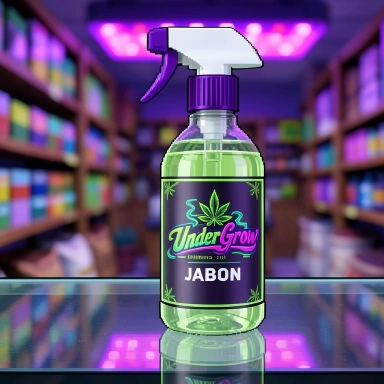
What it is
A soap made with vegetable oils and potassium (not kitchen detergent, which damages the leaves). It is one of the most used insecticides in home and organic growing.
How it works
It works by contact: it dissolves the protective coating of soft-bodied bugs (mites, whitefly, aphids) and dehydrates them. That's why it has to touch them: if it doesn't land on them, it does nothing. It leaves no poison and doesn't last: once dry, it no longer works.
How it is applied
- It's diluted in water (usually 1 to 2 %: 10 to 20 ml per liter).
- The whole plant is sprayed, especially under the leaves, where they hide.
- With the light off or at dusk: with strong light the drops burn the leaves.
- It's repeated every 3 to 5 days, 3 times, to kill what hatches from the eggs.
- Days later the plant can be rinsed with water to remove the residue.
Watch out
In late flowering don't spray the buds: residue and moisture stay inside (mold risk). It doesn't work against fungi.
After curing
Getting rid of the pest or mold stops the damage, but it does not give back what the plant already lost: eaten leaves do not come back and the plant recovers on its own, little by little. During those days it is best not to do anything else to it: no pruning, no training, no sudden changes. The longer it had the pest, the harder it is.
▲ Pros
- Kills spider mite and whitefly
- Cures them instantly: no need to repeat
▼ Cons
- Useless against fungus or thrips
- In flowering it always stains the buds
🎮 Practice it in UnderGrow
Cures spider mite and whitefly (tap the plant › treat). The starter kit comes with 2 uses (the shop sells 3); one use covers 10 plants of a batch. Doesn't work against thrips or fungus. In flowering it always leaves marks that lower quality, even if there's nothing to cure. Curing does not give health back: it rises on its own, only with the stress bar below 20 % (and that bar drops 1 % per game hour if nothing else happens to it). Until then, do not prune or train it.
▶ Play free